
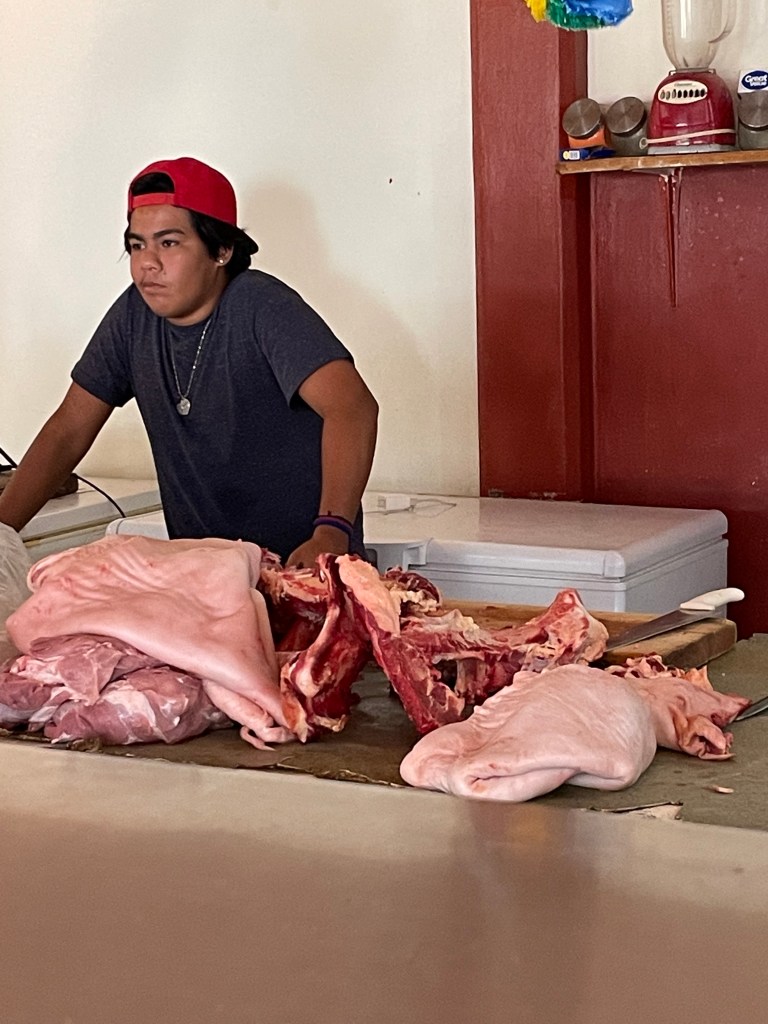
Carniceria 2023, Lo de Marcos, Nayarit
La obra de Sophie Green se caracteriza por emplear materiales orgánicos, texto, y dispositivos que utilizan la comida para ocasionar encuentros entre personas. Esos elementos buscan en todo momento recrear paisajes emocionales tanto para la autora como para quien se aproxima a ellos, así, mientras de pronto sus piezas ostentan una cierta rigidez o aspereza, en realidad abordan la vulnerabilidad de una manera inusual y provocadora. Los cuadros y objetos de Sophie Green, parecen casi salidos de un cuento de la ciencia ficción, y enaltecen las posibilidades de la sombra y de la oscuridad. Juegan con la luz y nos engañan por momentos, provocan al ojo humano y en general a los sentidos; invitan a querer tocarles, a caminarlos; a habitarlos y regocijar nuestro tacto en ellos.
Para su residencia en Apapacho, Green ha desarrollado una serie de piezas que como siempre, empujan los limites de lo bidimensional y lo tridimensional. Sus cruces. Dotan de colores brillantes a sus paisajes, quizás permeados por el entorno y la luminosidad de Lo de Marcos. También cobijan el relato de habitantes del lugar, con el cual construye un retrato, o postal, de talla en madera a partir de texto y dibujo, para enunciar el paisaje interior de quienes viven este lugar. Quizás un paisaje emocional colectivo. Es sobre este campo tallado que nos invita a reunirnos para comer, aceptarnos vulnerables, necesitados, acompañados, y en resistencia.
Con la desnudez de la piel (sus obras son siempre sensuales y de una profundidad psicológica) Sophie Green devuelve a este entorno natural y social un agradecimiento por el hospedaje y lo hace dejándose ver, pero también dándonos a nosotros un espacio para mostrarnos, y aceptar que somos luz, sombra, una sombra que, aunque oscura, a veces brilla, colorida y vibrátil.
Sophie Green’s work is characterized by the use of organic materials, text and methodologies that uses food to create encounters between people. These elements seek at all times to recreate emotional landscapes both for the author and for those who approach them. While her pieces suddenly display a certain rigidity or roughness, they actually address vulnerability in an unusual and provocative way. Sophie Green’s paintings and objects seems to belong to a science fiction story, exalting the possibilities of shadow and darkness. They play with light and deceive us at certain moments, provoking the human eye and our senses in general. They invite us to want to feel them, to walk them, to inhabit them and to rejoice our touch in them.
For her residency in Apapacho, Green has developed a series of pieces that, as always, push the limits and the intersections of two and three dimensions. This time her landscapes are loaded with bright colors, perhaps permeated by the surroundings and the light of Lo de Marcos. But they also embrace the stories of the inhabitants of this place, and with them the artist builds a portrait, or postcard -carved in wood with text and drawing- to enunciate the interior landscape of those who live here. It is perhaps a collective emotional landscape and it is on this carved field that she invites us to come together to eat, accept ourselves vulnerable, needy, accompanied, and in resistance.
With the nakedness of the skin (her works are always sensual and psychologically profound) Sophie Green returns to this natural and social environment a thank you for hosting. She does so by letting herself be seen, but also by giving us a space to show ourselves and accept that We are light, shadow, but a shadow that, although dark, sometimes shines, colorful and vibrant.
Lorena Peña Brito. Enero de 2023.
 Sophia Green